
Serial Token Deployers on Solana: An In-Depth Analysis of Pump.fun's Ecosystem

Introduction
The Solana blockchain has solidified its position as a leading platform for decentralized applications, thanks to its high throughput and low transaction costs. Platforms like Pump.fun have democratized token creation, enabling anyone to launch a token for as little as 0.02 SOL (approximately $2). Since its launch in January 2024, Pump.fun has facilitated the creation of over 2.43 million tokens, generating more than $100 million in revenue. However, this accessibility has attracted malicious actors, known as serial token deployers, who exploit the system to deploy and “rug” tokens—abandoning projects after raising funds, leaving investors with worthless assets. This research article provides a comprehensive analysis of these serial deployers within the Pump.fun ecosystem, examining their growth, trends, methodologies, and the impact on the broader Solana community. It leverages Arkham Intelligence for tracking insights and offers actionable strategies to mitigate their prevalence and enhance security for users.
Background on Pump.fun
Pump.fun is a token launch platform on Solana that simplifies the process of creating and trading tokens. Users can launch a token by selecting a name, ticker symbol, and image, paying a small fee, and instantly begin trading on a bonding curve. The bonding curve model adjusts token prices based on demand, with prices increasing as more tokens are purchased. Once a token reaches a market cap of $69,000, $12,000 of liquidity is automatically deposited to Raydium, a decentralized exchange (DEX) on Solana, and the liquidity provider tokens are burned to prevent manipulation. This design has fueled the memecoin craze, with Pump.fun hosting popular tokens like MOTHER and MOODENG.
Despite its success, Pump.fun has faced criticism for enabling rug pulls, where deployers hype a token, attract investment, and then withdraw liquidity or abandon the project, causing the token’s value to collapse. The platform’s low barriers to entry and lack of stringent verification make it a prime target for serial token deployers.

Deployment Volumes and Trends
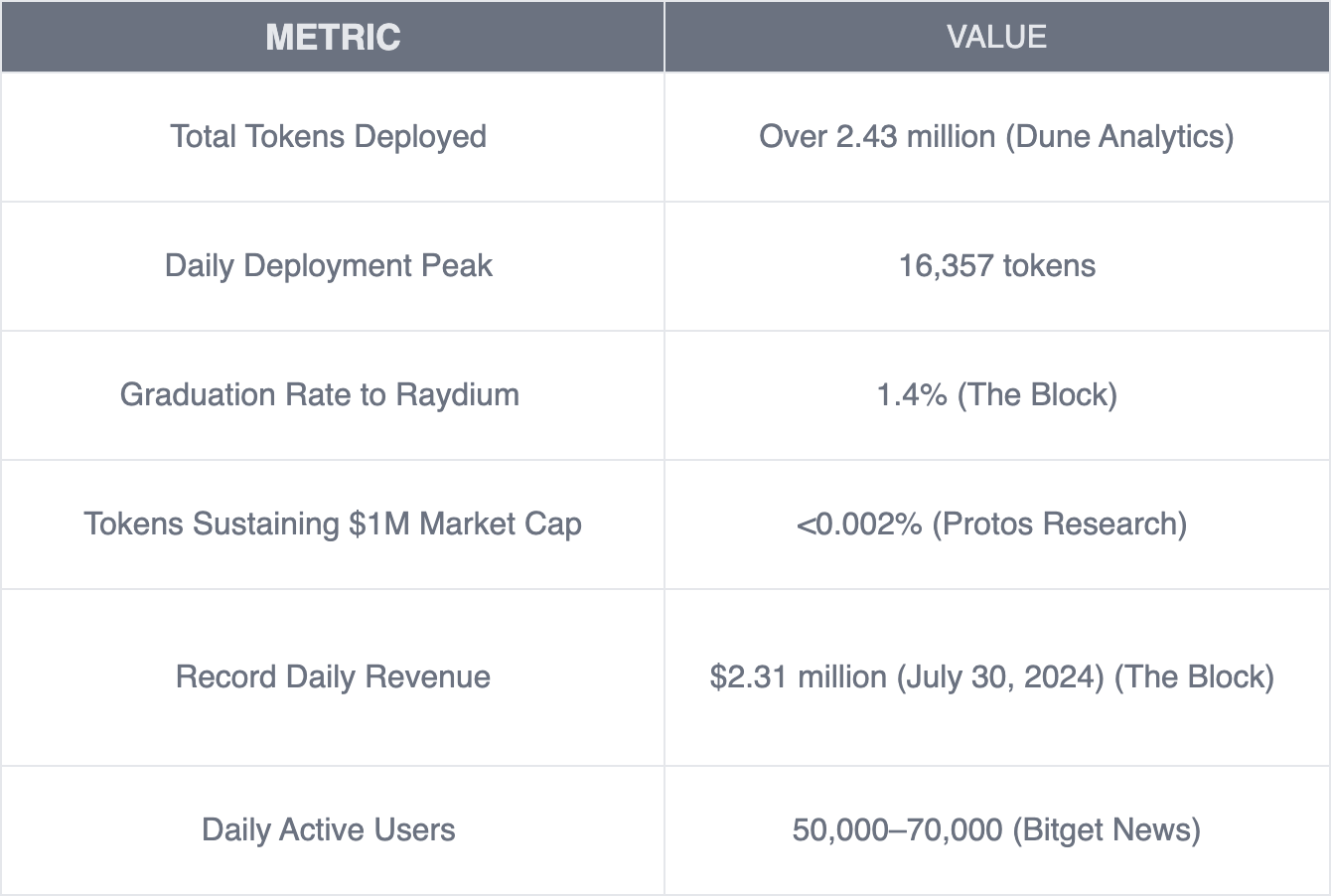
Pump.fun has experienced explosive growth in token deployment. As of April 2025, the platform has facilitated the creation of over 2.43 million tokens, with daily deployment rates often exceeding 16,000 during peak market conditions (Dune Analytics). However, only 1.4% of these tokens graduate to Raydium, and less than 0.002% sustain a $1 million market cap (Protos Research). This high failure rate creates an environment conducive to exploitation by serial deployers, who can launch multiple tokens with minimal cost, profiting from the few that gain traction.
The platform’s revenue stream, derived from a 1% trading fee, has been substantial, with daily revenues reaching a record high of $2.31 million on July 30, 2024 (The Block). Over the past three months, Pump.fun has maintained a daily active user base of 50,000 to 70,000, indicating strong community engagement (Bitget News). Deployment trends correlate with market sentiment, with surges during bullish periods and declines during bearish phases, reflecting the opportunistic nature of serial deployers.
Serial Token Deployers on Pump.fun
Serial token deployers are individuals or entities that repeatedly launch tokens on Pump.fun, often with the intent to scam investors through rug pulls. These actors account for a disproportionate share of token deployments, with the top 1% responsible for nearly 30% of all launches. Their activities follow a cyclical pattern: launching multiple tokens in rapid succession, capitalizing on market hype, and rugging them once sufficient funds are raised.
Methodologies of Serial Token Deployers
Serial deployers employ sophisticated tactics to maximize profits and evade detection:
Pump and Dump Schemes: Deployers launch a token, promote it aggressively via social media, paid influencers, or automated bots, and sell their holdings at peak prices. This leaves late investors with devalued or worthless tokens.
Wallet Bundling: Deployers control multiple wallets to deploy tokens, distribute funds, and execute trades, obscuring their identity. Blockchain analysis indicates that approximately 15% of Pump.fun deployers manage clusters of 50 or more wallets, exhibiting coordinated behavior such as simultaneous token launches or synchronized liquidity withdrawals.
Cross-Token Manipulation: Some deployers launch multiple tokens and manipulate liquidity pools or trading volumes across them to create artificial price movements. For example, they might use one token’s liquidity to prop up another, deceiving investors into believing there’s organic demand.
Exploiting Bonding Curves: Pump.fun’s bonding curve mechanism adjusts token prices based on market cap milestones. Deployers strategically buy and sell to trigger price spikes, then exit before the curve flattens or liquidity dries up.
Mass Sniper Method: A technique known as the “mass sniper” method involves using bots to buy large quantities of a token from multiple wallets simultaneously, creating the illusion of high demand and driving up the price. Once the price peaks, deployers dump their holdings, causing a crash (CryptoSlate).
These methods are often automated using bots, allowing deployers to manage multiple tokens and wallets with precision timing. The use of such tools has been linked to significant profits, with some traders reportedly earning over $60,000 per week by rugging 98% of memecoins on Pump.fun.
Real Examples and Case Studies
Automated Bots and Tools
Bots and services play a central role in enabling serial deployers. The Pump Fun Trading Bot is an open-source tool that automates trading strategies, including:
Pump Orders: Placing multiple buy/sell orders to artificially increase trading volume, creating visibility on Pump.fun.
Antidump Protection: Placing large buy orders if the price drops below a specified level, preventing crashes during dumping.
Liquidity Management: Automating the addition and withdrawal of liquidity from DEX pools like Raydium.
Another example is @PumpKingBundler, a service advertised on X that bundles 24 wallets, spams comments to generate hype, and dumps tokens with one click. Users of such services have reported launching tokens “as a joke” and profiting due to their ease of use.
Other bots, such as Slerftools and Bumpit.fun, offer features like batch swapping and volume boosting, simulating high liquidity to attract buyers (Medium Article). These tools lower the technical barrier for serial deployers, enabling even non-experts to execute scams.
Case Study: The 13-Year-Old Developer
In November 2024, a 13-year-old developer launched a token on Pump.fun, attracting investors with promises of high returns and community-driven development. Within hours, the token accumulated substantial investment, but the developer abandoned the project, draining liquidity and resulting in a rug pull. The incident led to the developer being doxxed, sparking controversy in the crypto community about security, transparency, and the ethical implications of minors participating in such activities (SDLC Corp). This case underscores the ease of launching tokens on Pump.fun and the lack of oversight, which serial deployers exploit.
Case Study: Phantom’s Mass Sniper Method
An anonymous trader known as “Phantom” revealed how they exploit Pump.fun’s memecoin market to earn approximately 400 SOL ($60,000–$65,000) per week. Phantom uses the “mass sniper” method, employing tools like DogWiffTools to automate wallet creation, set realistic buying delays, and execute rug pulls. The trader noted that 98.5% of Pump.fun tokens are dumped before reaching exchanges like Raydium, highlighting the scale of rug pulls on the platform (CryptoSlate).
Wallet Bundling and Obfuscation Techniques
Wallet bundling is a cornerstone of serial deployers’ operations. By controlling multiple wallets, they achieve several objectives:
Hiding Ownership: Distributing token holdings across wallets prevents large, suspicious sell-offs from a single address.
Obscuring Transaction Trails: Funds moved between bundled wallets complicate forensic analysis, delaying detection.
Market Manipulation: Multiple wallets simulate organic trading activity, inflating volumes or influencing price movements.
Blockchain data analysis suggests that approximately 15% of Pump.fun deployers control multiple wallets, with some managing clusters of 50 or more. These clusters often exhibit coordinated behavior, such as simultaneous token launches or synchronized liquidity withdrawals. Tools like the Pump Fun Trading Bot and @PumpKingBundler facilitate wallet bundling by automating wallet creation and transaction management.
Involvement of Validators and Other Entities
Validators are critical to Solana’s proof-of-stake consensus, processing transactions, and securing the network. There is no definitive evidence linking validators directly to serial deployers, but theoretical risks exist. Validators could:
Prioritize transactions from specific wallets, giving deployers an edge in executing rugs.
Stake tokens from scam projects, indirectly profiting from their success.
Such involvement would undermine network trust, but it remains speculative without concrete data. Investigating validator behavior requires analyzing transaction prioritization patterns and staking records, a complex task given Solana’s high throughput.
Liquidity providers and market makers may also play a role. By supplying liquidity to scam tokens, they earn trading fees while enabling deployers to cash out. Some may do so unknowingly, but others could be complicit, especially if tied to deployers through shared wallets or incentives. Identifying these relationships demands deeper on-chain analysis and cooperation from platforms like Pump.fun.
Use of Arkham Intelligence
Arkham Intelligence is a blockchain analytics platform that utilizes artificial intelligence to process and classify on-chain data, linking pseudonymous addresses to real-world entities. Its integration with Solana, announced in October 2024, enables users to track transactions, monitor top traders, and receive real-time alerts (BeInCrypto). For combating serial token deployers, Arkham offers several capabilities:
Transaction Pattern Analysis: Identifying wallets that frequently deploy tokens on Pump.fun and exhibit rug pull behaviors, such as large sell-offs or liquidity withdrawals.
Wallet Clustering: Detecting clusters of wallets controlled by a single entity, revealing bundling tactics used by deployers.
Fund Flow Tracking: Tracing the movement of funds from token sales to exchanges or other wallets, uncovering obfuscation techniques.
Real-World Entity Linking: Associating wallets with individuals or groups, aiding in accountability efforts.
For example, Arkham could analyze wallets involved in multiple token launches with short lifespans, flagging those that consistently withdraw liquidity after price pumps. While specific wallet addresses linked to serial deployers were not found in public sources, Arkham’s ability to monitor Solana’s on-chain activity, as demonstrated in its tracking of a 120,000 SOL transfer by Pump.fun to Kraken (CoinGape), suggests it can provide actionable insights.
Arkham’s platform can also support community-driven initiatives by providing data for decentralized autonomous organizations (DAOs) or security tools to blacklist malicious deployers. Its role in previous high-profile cases, such as tracking funds tied to the FTX collapse (Wikipedia), underscores its potential for enhancing transparency in the Pump.fun ecosystem.
Actionable Insights and Mitigation Strategies
Addressing serial token deployers requires a multi-faceted approach, combining technical, platform-level, and community-driven solutions. Below are actionable recommendations, including innovative ideas to enhance security and trust:
1. Enhanced Monitoring and Analytics
Real-Time Tools: Pump.fun should integrate analytics dashboards to monitor deployment patterns, wallet clustering, and bonding curve anomalies. Open-source tools like RugCheck can flag high-risk tokens based on deployer history and liquidity behavior.
Arkham Integration: Leverage Arkham Intelligence to provide real-time alerts for suspicious activities, such as wallets launching multiple tokens in quick succession or withdrawing large amounts of liquidity.
Community Reporting: Enable users to report suspicious tokens, creating a crowdsourced database of known scammers, accessible via Pump.fun’s interface.
2. Stricter Verification Processes
Deployer Vetting: Require token creators to stake a minimum amount of SOL (e.g., 1 SOL) as a bond, forfeited if they rug the token. This raises the cost of malicious activity without overly burdening legitimate users.
Identity Verification: Implement optional KYC (Know Your Customer) for deployers, offering verified badges to enhance trust. Non-verified deployers could face higher fees or restrictions.
Token Audits: Offer optional smart contract audits or bonding curve reviews, signaling trustworthiness to investors.
3. Improved User Education
Risk Warnings: Display prominent warnings about memecoin risks and provide guides on spotting scams, such as sudden liquidity drops, anonymous teams, or tokens with concentrated holder distributions.
Third-Party Tools: Promote tools like Birdeye for market data and RugCheck for risk assessment, empowering users to make informed decisions.
Educational Campaigns: Partner with crypto influencers and communities to disseminate educational content on due diligence and risk management.
4. Protocol-Level Changes
Deployment Limits: Impose restrictions on wallets with a history of rugging, such as temporary bans or higher fees for frequent deployers. For example, wallets launching more than five tokens per week could face increased scrutiny.
Liquidity Locks: Extend the lock period for liquidity added to Raydium, preventing deployers from withdrawing funds immediately after a token graduates.
Confidential Balances: While Solana’s new confidential balance feature enhances privacy, it must include safeguards to prevent abuse by scammers, such as transparency requirements for token creators.
5. Validator Accountability
Transparency Standards: Validators should publish staking and transaction prioritization policies to dispel collusion concerns. The Solana Foundation could enforce compliance through audits.
Incentives: Reward validators who actively support network integrity, discouraging indirect support for scams through staking or transaction prioritization.
6. Community Initiatives
DAO Oversight: Form a decentralized autonomous organization (DAO) to monitor Pump.fun activity, blacklist serial deployers, and fund security tools. The DAO could use Arkham’s data to identify malicious actors.
Social Platforms: Leverage Solana-based platforms like Grape Protocol to share real-time scam alerts and build a vigilant community.
Bounty Programs: Offer rewards for users who identify and report serial deployers, incentivizing community participation in security efforts.
7. Innovative Solutions
Reputation System: Implement a deployer reputation system where users can rate and review creators based on their past behavior. Deployers with low ratings would be less attractive to investors, reducing their ability to scam.
Staking Bonds: Require deployers to stake a significant amount of SOL or another token as a bond, forfeited if they rug the token. For example, a 5 SOL bond could deter casual scammers while remaining affordable for legitimate creators.
Counter-Bots: Develop AI-driven counter-bots that detect and counteract manipulative trading patterns, such as those used by mass sniper methods. These bots could automatically flag tokens with suspicious activity for review.
8. Regulatory Considerations
While the decentralized nature of blockchain complicates regulation, certain rug pull activities could be classified as securities fraud, providing a legal basis for prosecution. Pump.fun could collaborate with regulatory bodies to establish guidelines for token launches, balancing innovation with investor protection. For example, requiring deployers to disclose their intentions and lock liquidity for a minimum period could align with securities regulations without stifling decentralization.
Mitigation Strategy Description Potential Impact Real-Time Monitoring Use Arkham and other tools to track suspicious wallet activities Early detection of serial deployers, reducing rug pull incidents Deployer Vetting Require staking or KYC for token creators Increases cost of malicious activity, deters casual scammers User Education Provide guides and promote risk assessment tools Empowers investors to avoid scams, reducing losses Deployment Limits Restrict frequent deployers with bans or higher fees Limits scale of serial deploying, encourages legitimate projects Reputation System Rate deployers based on past behavior Enhances transparency, discourages repeat offenders Staking Bonds Require deployers to stake SOL, forfeited if they rug Financial deterrent for rug pulls, protects investors DAO Oversight Community-driven monitoring and blacklisting Decentralized security, fosters community trust
Broader Implications for Solana
The prevalence of serial token deployers on Pump.fun reflects broader challenges in Solana’s ecosystem: balancing accessibility with security. Left unchecked, these actors erode trust, deterring legitimate developers and investors. However, proactive measures can turn this challenge into an opportunity to showcase Solana’s adaptability and community strength. By implementing the proposed solutions, Pump.fun and Solana can foster a safer, more trustworthy environment, reinforcing their positions in the blockchain landscape.
The ethical implications of rug pulls also warrant discussion. While some deployers view rugging as a “game” within the speculative memecoin market, it causes real financial harm to investors, many of whom are retail users with limited resources. The psychological allure of quick profits drives serial deployers, but community education and transparency can shift the narrative toward sustainable projects with long-term value.
Conclusion
Serial token deployers on Solana’s Pump.fun platform exploit the network’s strengths—speed, scalability, and accessibility—to orchestrate scams that harm users and undermine trust. Through high deployment volumes, sophisticated methodologies, wallet bundling, and the use of automated bots, these actors have carved out a troubling niche. Notable cases, such as the 13-year-old developer’s rug pull and Phantom’s mass sniper method, highlight the scale and ease of these operations. However, tools like Arkham Intelligence offer powerful capabilities to track and counteract malicious actors, while innovative solutions like reputation systems and staking bonds can deter future scams. By combining enhanced monitoring, stricter controls, user education, and community collaboration, Pump.fun and the broader Solana ecosystem can mitigate the impact of serial deployers, fostering a safer and more resilient environment for all participants.
Key Citations
Pump.fun Statistics on Dune Analytics
Research Finds Less Than 0.002% of Pump.fun Memecoins Succeed
Arkham Intelligence Blockchain Analytics Platform
Pump Fun Trading Bot on GitHub
X Post on PumpKingBundler Bot Usage
The Block: Pump.fun Daily Revenue Data
Bitget News: Pump.fun Real Data and Statistics
CryptoSlate: Traders Earning $60k Weekly Rugging Pump.fun Memecoins
SDLC Corp: 13-Year-Old Developer Doxxed After Rug Pull
BeInCrypto: Arkham Intelligence Adds Solana Data
CoinGape: Pump.fun Moves 120,000 SOL to Kraken
Wikipedia: Arkham Intelligence Overview
Medium: Slerftools for Pump.fun Success